
Canton City Directory Collection Runs
The Canton Public Library holdings guide identifies a local “Directory of residents” series with explicit gaps. The library describes entries as carrying a name, address, occupation, and year of birth. Its sheet does not identify a publisher or imprint, so a publisher should not be supplied until a physical title page or scan is checked. A listed address establishes what the volume printed for that edition; it does not establish ownership, present residence, or a complete household. The historical shelf is most useful when each result is marked with its volume year and then compared against another dated record.
| Collection | Years | Where Held | Access |
|---|---|---|---|
| Directory of residents | 1939–47, 1949–50, 1952–53, 1955–61, 1963–64, 1966–current | Canton Public Library, Edward Bolster Local History Room | Local history collection and reference help |
| State Library catalog leads | Selected Canton material in the 1874–1942 range | Massachusetts State Library | Verify each catalog item and shelf record |
| BPL catalog leads | About 1902, 1906–11, and 1920 | Boston Public Library genealogy holdings | Verify the exact item before relying on it |
| Telephone books | 1956; 1995–2002; 2006–current, not inclusive | Canton Public Library | Subscriber and address clue |
The State Library and Boston Public Library entries are catalog leads, not confirmed continuous Canton runs. They can point to an older volume outside the local shelf, but item-level verification comes first.
Canton City Directory Room
The Edward Bolster Local History Room at Canton Public Library, 786 Washington Street, is the practical starting point for the resident-directory volumes and their companions. Regular posted hours are Monday 1–9; Tuesday through Thursday 10–9; Friday and Saturday 10–5:30; Sunday closed. The room also connects researchers with annual reports, voter and poll-tax lists, valuation material, yearbooks, newspapers, genealogies, and reference assistance. Cardholders can reach additional research sources, while Ancestry Library Edition is available in the building. Bring a surname spelling, a street name, and a rough date rather than asking for an undated all-name search.
The local-history page also points researchers toward digital collections and guides. That makes the room a useful fallback when a catalog record identifies a volume but does not settle its publisher, page arrangement, or access condition. The library’s holdings include family genealogies, town histories, military reference works, and annual reports as well as the directories. Ask the Reference Desk for the relevant collection and date range, then cite the volume or page actually consulted. A useful result records the title, year, page, name form, and address exactly as printed.
The Library’s local-history page shows the room that anchors a Canton city directory search.
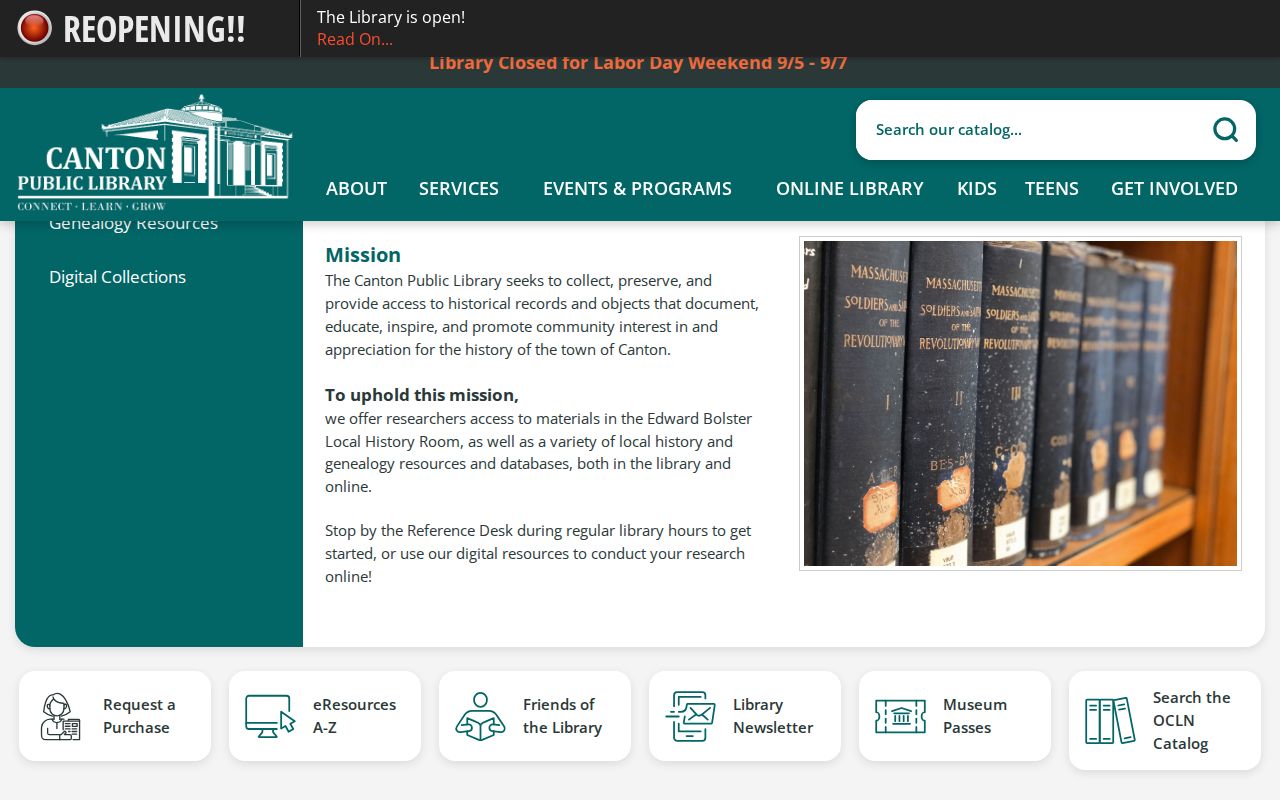
Use the room to confirm a volume’s title page, date, and page context before copying a result into a household timeline.
Canton City Directory Gaps
The numbers matter here. The local resident-directory run is 1939–47, then 1949–50, 1952–53, 1955–61, 1963–64, and 1966 forward. A missing volume year is a collection gap, not proof that a person or family left Canton. The same caution applies to the library’s phone-book sequence: 1956, 1995–2002, and 2006 to the current holdings, with the library expressly describing those phone books as not inclusive. Telephone directories usually follow subscriber and service-area practices, so absence can reflect an unlisted number or a different service boundary.
Timeline check. Record the first and last confirmed directory years, then mark the unheld intervals before drawing any conclusion about a move or death.
Gaps also appear in nearby collections. Canton High School’s The Echo holdings omit 1961 and 1976. A yearbook can support a school-era association, but it cannot prove a later Canton address.
Reading a Canton City Directory Entry
Use only the fields actually observed in the Canton volume. The library’s holdings description supports name, address, occupation, and year of birth. An alphabetical page may present a surname followed by given name or initials, while a house-guide or address portion, if present in the particular volume, can support a street-to-name check. Do not expand a short printed line into facts the book does not state. In particular, no scanned Canton page was available in the source inspection to verify spouse, owner, renter, widow, or other abbreviation conventions. Photograph or note the page heading and any abbreviation key before interpreting a mark.
| Observed field | What it can document |
|---|---|
| Name | Printed surname plus given name or initials on the entry. |
| Address | The address reported for that directory year, not a present-day location claim. |
| Occupation | The occupation field printed in the directory, where shown. |
| Year of birth | The year-of-birth field described by the library for the local series. |
| Unverified abbreviations | Spouse, owner, renter, widow, and similar marks require confirmation from the actual Canton page and key. |
Terms to check. A criss-cross directory is arranged by address rather than name. A householder index is an address-oriented listing when a volume includes one. An abbreviation key explains that edition’s shorthand, so it should be read rather than assumed.
Canton City Directory Address Trails
Canton’s library guide does not identify a dedicated reverse-directory title or a complete reverse run. Start with the name and the exact street and number found in a resident directory. If that edition has a house guide or address section, work back from the street to the printed names. If it does not, use the directory entry as a dated clue and compare phone books, annual reports, valuation books, voter lists, assessor material, deeds, and fire-insurance maps. This keeps the city directory in its proper role: a historical address clue that needs source-by-source confirmation.
A changed number may reflect a genuine move, an error in a printed volume, or an address change that still needs mapping. Canton has no verified townwide renumbering or renaming year in the research, so an old number should never be automatically treated as its modern equivalent.
Canton City Directories Across Censuses
For family history, a Canton city directory works best as a sequence rather than a single hit. Begin with the first confirmed appearance in the local run, then compare spelling, initials, street number, and nearby names in the next held years. Pair that timeline with the public federal census, which covers 1790–1950 under the National Archives’ 72-year access rule. Census schedules can add household composition, ages, birthplace, and address or geography, while a directory adds the city-scale date between decennial counts. Neither one by itself settles every identity question.
- Choose a surname, a known street or number, and the earliest likely Canton year.
- Check the 1939–47 volumes, then compare each later held run in order.
- Copy the exact name form, address, occupation, and year of birth only where printed.
- Match the sequence to the closest census year and note any household or geography difference.
- Test a disappearance with newspapers, cemetery sources, a deed trail, or a later directory, rather than treating it as a conclusion.
Note: A directory address and a census household are dated observations, so preserve both dates instead of merging them into one undated profile.
Canton City Directory Companions
When a resident-directory gap interrupts the trail, the library offers several dated bridges. Its annual reports begin in 1842, with bound volumes from 1859. Historical voter lists include 1893–96, 1898–99, 1904–06, 1915, 1917, and 1919, while poll-tax lists cover 1923–38. Valuation and tax material survives for 1856, 1868, 1882–83, 1891, 1936, 1949, and 1970. These are not interchangeable resident lists. A voter list reflects its historical eligibility rules, and an ownership or valuation item is not proof that the owner lived at the property.
Yearbooks supply a different companion trail. The library lists The Echo for 1924, 1931, 1935–36, 1937–38, 1940, 1951, 1956–60, 1962–75, and 1977 to the current holdings, plus alumni registers and directories. Blue Hill Regional yearbooks are held for 1994–96 and 2000. Use a class year, initials, family clue, and dated address carefully. A yearbook appearance can support an association with a school year, but it does not establish a later Canton address.
Local newspapers on library microfilm run from the 1880s forward. For a date or family name, they can provide marriage notices, obituaries, school notes, civic mentions, and probate notices that help explain a gap in the city directory trail. The Historical Society’s Canton Journal run is 1880–1950. Neither source is described as a complete online obituary index, so a missed web result should lead back to the relevant microfilm or archive.
Canton Before Its 1797 Incorporation
Canton was part of Stoughton before it became a separate town on February 23, 1797. That predecessor jurisdiction changes the search terms for an early person or parcel. A name missing from a later Canton directory cannot be expected in a town that did not yet exist, so search Stoughton and related early-town records, then reconnect the finding to a dated Canton street, deed, map, or family record. Canton’s preservation work also identifies early colonial records as an active digitization concern, which makes the Library and Historical Society useful places to ask about newly available material.
Canton City Directory Archive Help
The Canton Historical Society provides another local-history route when a directory name needs context. Its research collection reaches to the mid-17th century and includes more than 7,000 photographs, 1,500 books, about 3,200 Canton Journal issues from 1880–1950, 900 maps, family papers, ephemera, and partial Saint Mary’s and Canton Corner cemetery coverage. The Society offers custom research and describes assistance as free, with donations appreciated. Its contact and appointment model is more accurate than suggesting a comprehensive open resident database.
The Historical Society research page introduces the scale of the archive available alongside Canton city directory volumes.
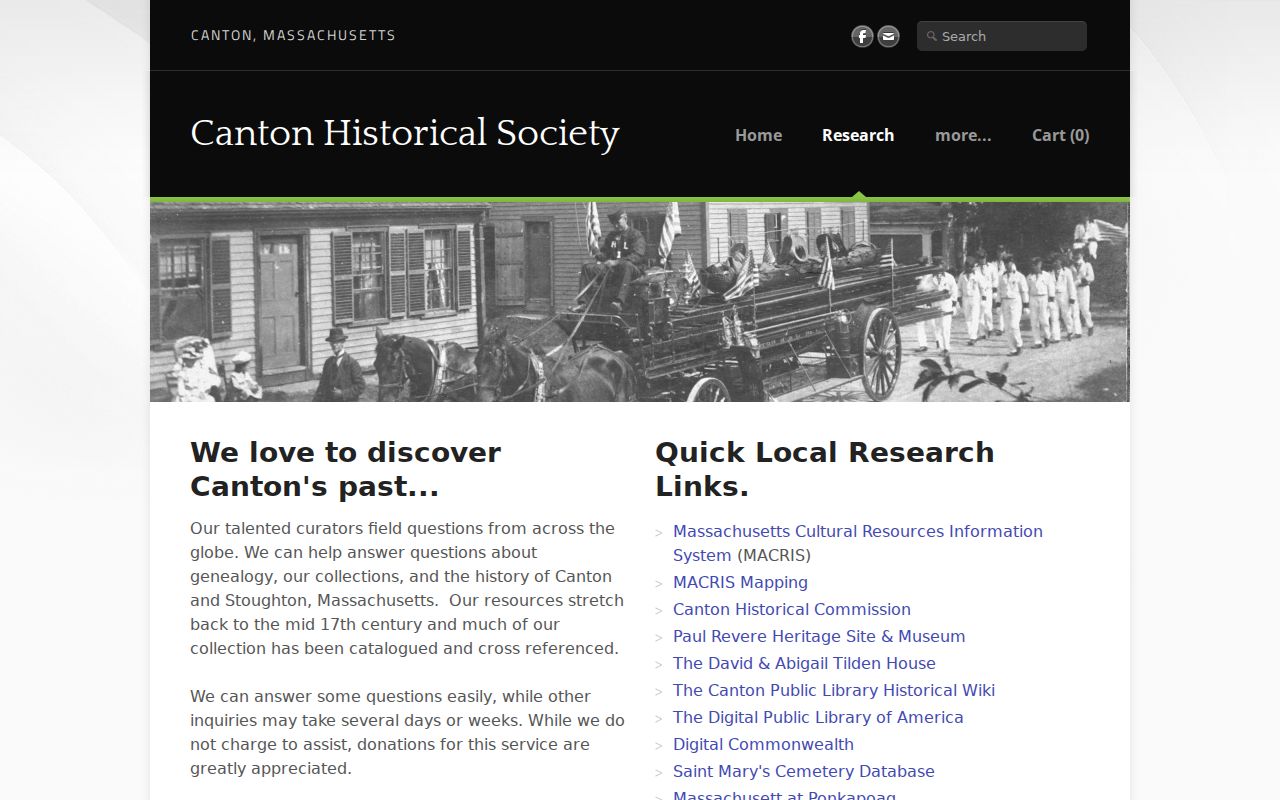
A map, newspaper notice, family letter, or cemetery reference can test a historical directory lead without changing its original date or scope.